The Carbon Deadline
CLIMATE-ADJUSTED ACCOUNTING
(THE NEW IFRS/GAAP)
A Ready-Reckoner for Financial Regulators, CFOs, Controllers and the Auditors Who Sign Off Their Numbers
THE SPREADSHEET PARADOX
Every CFO in the book knows the moment. The geothermal plant at Meridian Global costs €120 million and saves €9.6 million a year. Payback takes 12.5 years, the ten-year NPV is negative, and the board rejects it. The plant fails the three- to five-year payback rule and any ten-year test. By every rule on the spreadsheet, the board is right. The same spreadsheet has no line for the fact that Meridian loses market access after 2035 if it never builds the plant. The investment that keeps the company alive therefore looks like a bad investment now.
Traditional accounting was built for stable conditions. It assumes the business continues, the past repeats itself, and technology changes gradually. A regulatory deadline that can render a factory worthless, a supply chain that breaks down within months, an insurer who stops quoting at any price: none of these fits the assumptions, so none of them shows up in the numbers.
Climate-Adjusted Accounting, developed by Dr Helen Morrison in the book and endorsed by the European Central Bank in October 2030, maintains financial discipline while broadening the lens. This is the book’s proposal. No regulator has adopted it yet, and the ECB endorsement is part of the story. This appendix is a technical reference for finance professionals who want to see the mechanics: the NPV method, what other jurisdictions have already done, changes to GAAP and IFRS, and the rollout.
A. THE CLIMATE-ADJUSTED NPV
Where the old method falls short
The traditional formula discounts the net cash flows of an investment and deducts the initial outlay:
NPV = Σ [Ct / (1 + r)^t] − C0
Ct is the net cash flow in period t, r the discount rate, t the number of periods and C0 the initial investment. For climate projects, most companies count only the energy savings over 10 to 15 years at 5 to 8%. That approach ignores what happens after the payback period, the shutdown costs of a missed deadline, the competitive edge of a resilient supply chain, lower insurance premiums, and the value of staying in the market. The investments that matter most get the lowest score.
The extended formula
CA-NPV = Traditional NPV + BCV + RCV + SCRV + PAV
Four values are added to the traditional result.
Business Continuity Value (BCV) is the value of staying in business. It equals the difference between expected revenue with and without compliance, multiplied by the probability of enforcement and a present value factor. Under the Four Ones with a 2040 deadline, expected revenue without compliance is zero because market access is gone, enforcement is certain, and the terminal value consists of all business cash flows from the deadline onwards. To avoid double counting, the BCV includes only cash flows that RCV, SCRV and PAV do not already capture. This is the heavyweight of the four.
Regulatory Compliance Value (RCV) adds up avoided penalties, avoided shutdown costs, and compliance staff savings. For a manufacturer with €500 million revenue, three compliance employees at €85,000 each save €255,000 a year, and streamlined regulatory reporting adds another €100,000 to €200,000. The avoided shutdown, worth the entire annual revenue, dwarfs both.
Supply Chain Resilience Value (SCRV) is the competitive advantage a company gains when rivals with fragile supply chains fail during climate events or enforcement rounds, plus the cost of alternative sourcing it does not have to pay. A supplier risk assessment makes it measurable.
Physical Asset Protection Value (PAV) counts the losses avoided through adaptation: coastal facility protection against rising seas, flood defences, heat-resistant infrastructure. The value is asset write-offs plus the business interruption that didn't happen.
The numbers for a German manufacturer
The case study uses a German discrete manufacturer.[1] Revenue is €500 million and cost of sales 80% (€400 million). Materials make up 80% of cost of sales (€320 million), and energy costs 3% of materials (€9.6 million a year). Own generation replaces 70% of purchased energy, saving €6.72 million a year; three compliance staff at €85,000 add another €0.255 million, so direct savings total about €6.98 million a year. Operating profit is 10% of revenue (€50 million). The discount rate is the cost of capital. The base case uses 5%, in line with current European interest rates, and after the deadline operating profit grows by a deliberately conservative 2% a year. The table shows the most the company can justify spending: the present value of the direct savings plus the present value of staying in business after the deadline. The figures in brackets show it as a share of annual revenue.
Two things stand out. Business continuity dominates the result. For a 2035 deadline without inflation, it contributes €1,044 million against €54 million of direct savings, so the energy bill explains less than 5% of what the company can afford to spend. Inflation then raises both parts, because savings and profits grow in nominal terms while the discount rate stays at 5%. The effect grows with the horizon.
How robust is the result?
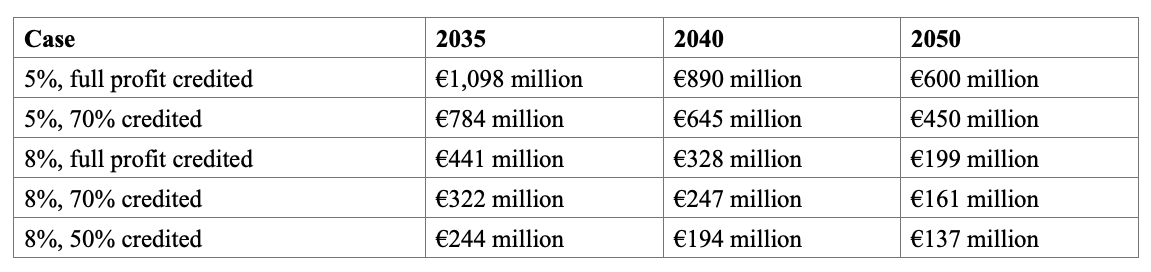
The base case counts the whole post-deadline operating profit as continuity value at a 5% cost of capital. A sceptical reader will challenge both assumptions, so the table below shows the same calculation, without inflation, at an 8% cost of capital and with only 70% or 50% of the operating profit credited as continuity value.
The justified investment exceeds €100 million in every case, against direct savings of about €7 million a year. The conclusion therefore does not depend on a low discount rate or on full profit conversion.
What a deadline extension is worth
The time value of money turns the deadline into a number. At 2.0% inflation, moving the deadline from 2035 to 2040 is worth €148 million, or about €30 million per year of delay. Moving it to 2050 is worth €388 million, or about €26 million per year. Three conclusions follow for any CFO:
• An earlier deadline requires a larger investment in present value terms and rewards first movers with a lead over rivals.
• A later deadline enables phased investment aligned with the normal capital replacement cycle.
• Even in the most cautious case, the justified investment exceeds €100 million. Energy savings alone never get there.
Lobbying for delay has a measurable payoff, which makes it tempting. It also leaves the company standing still while competitors (‘survival of the greenest’) collect the lead.
Back to Meridian
Meridian is much larger than the case study manufacturer, with a market capitalisation of roughly €5 billion, and has its own figures. Under the traditional method, the €120 million geothermal plant saves €9.6 million a year, has a payback of 12.5 years, and fails the three- to five-year payback rule and any ten-year test. Under the Climate-Adjusted method, Meridian first recognises its climate exposures, which have a present value of €2.4 billion. The plant eliminates 95% of Scope 1 and 2 emissions and reduces the non-compliance exposure by €800 million in present value terms. With protection against energy price spikes and 30 years of stable energy costs, the project shows an IRR of 18%, a 6-year payback, and an NPV of €850 million over its life. The board that rejected the plant now would approve it as a survival investment.
B. WHAT OTHER JURISDICTIONS HAVE ALREADY DONE
The book’s standard builds on existing practice, and none of the pieces is exotic. Three jurisdictions show how far regulators can go without rewriting the accounting rulebook.
The European Union extended the annual report. Companies in scope of the Corporate Sustainability Reporting Directive publish climate-related impacts, risks, targets and transition plans in a sustainability statement inside the management report, and an auditor provides limited assurance. The 2026 Omnibus reform has narrowed the scope to companies with more than 1,000 employees and €450 million in turnover, showing how fragile a purely disclosure-based approach can be. The lesson is that the existing framework can support long-term value recognition.
Canada shows what federal systems can do. The Canadian Securities Administrators proposed a TCFD-based disclosure rule (National Instrument 51-107), and the Office of the Superintendent of Financial Institutions set climate risk management expectations for federally regulated financial institutions in Guideline B-15. A caution for financially inclined readers: the CSA paused its work on the mandatory rule in April 2025, showing how fragile a purely disclosure-based approach can be.[2]
Australia is the enforcement example. APRA requires regulated entities to manage climate risk and hold boards accountable, and ASIC treats material climate risk as a disclosure duty under existing securities law, with director liability and penalties for greenwashing. Australia combined this securities-law enforcement with a 2024 statute that made AASB S2 mandatory, and since 1 January 2025 the standard has phased in climate-related financial reporting, starting with the largest entities. The lesson is that securities law can carry climate disclosure, and a reporting statute makes it mandatory.
Across all three, the common threads are a baseline disclosure standard (the TCFD framework, which the IFRS Foundation took over in 2024 through the ISSB), climate scenarios within financial projections, enforcement through securities law and independent attestation. Climate-Adjusted Accounting goes further in five ways. It provides quantitative methods for business continuity value, a single NPV framework, mandatory GAAP changes where others offer voluntary disclosure, climate metrics in the core financial statements, and a single rule for every sector and every company with revenue above €50 million.
C. THE CHANGES TO GAAP AND IFRS
The proposed changes follow the same path GAAP and IFRS have always taken. In the US, Sarbanes-Oxley (2002) addressed fraud risk, ASC 606 (2014) addressed revenue recognition, ASC 842 (2016) addressed lease obligations that sat off the balance sheet, and ASC 326 (2016) addressed the timing of credit losses. IFRS moved in parallel with IFRS 15 (issued 2014, effective 2018) for revenue, IFRS 16 (issued 2016, effective 2019) for leases, and IFRS 9 (issued 2014, effective 2018) with its expected credit loss model. IFRS 16 is the best example for a European reader. From one reporting period to the next, airlines, retailers, and logistics groups had to report billions of euros in lease obligations that had stayed off their balance sheets. Each time, the numbers brought a hidden risk to light. IFRS already holds the tool for the climate version. IAS 37 and IFRIC 1 require companies to book decommissioning and restoration costs long before they fall due, but only where a present obligation exists from a past event, and a regulatory deadline alone does not create one today (IAS 37, paragraphs 14 and 63). Climate-Adjusted Accounting closes that gap. It makes transition risk visible before the regulatory deadline, rather than a footnote to read afterwards. In practice, the IASB would issue the standard, and the European Commission would endorse it.
Depreciation that follows the deadline
IAS 16 already requires the useful life of an asset to reflect legal limits on its use (paragraphs 51 and 56(d)), so once a deadline becomes law, depreciation shortens under current IFRS. The proposed standard applies the same logic earlier: when the regulatory deadline falls before the end of a physical asset’s useful life, the depreciation period shrinks to the deadline. Take a plant with a book value of €100 million and 15 years of physical life left. If the compliance deadline is 2035, five years after the reporting date, the annual charge triples. Regulatory obsolescence will render the asset worthless long before it wears out, and spreading its cost over 15 years overstates its value and understates its running costs.
Booking the liability
A company recognises the present value of future climate-related costs when the regulatory deadline is set with high certainty, non-compliance has a measurable business impact, and the costs can be reasonably estimated. The recognised items include probability-weighted non-compliance costs, expected supply chain disruption costs, higher insurance premiums, climate adaptation requirements for physical assets, and lost revenue from market access restrictions. For Meridian, the present value of these climate exposures is €2.4 billion: €1.8 billion in probability-weighted lost revenue from a regulatory shutdown, €400 million in supply chain disruption, €150 million in insurance premium increases, and €50 million in coastal facility risk.
Not all of this would qualify as a liability under today’s IAS 37. Obligations arising from past events, such as the adaptation work and the premium increases, are candidates for a provision. Lost revenue and supply chain disruption are revenue at risk. They belong in impairment testing, the going-concern assessment and disclosure, and IAS 37 does not allow a provision for future operating losses. The proposed standard would move the first group forward in time and require quantifying and disclosing the second group. The IASB’s December 2025 illustrative examples on climate-related and other uncertainties in financial statements point in the same direction.
Impairment tests with climate scenarios
The annual impairment test must run physical-risk scenarios (flooding, heat stress, water scarcity), transition-risk scenarios (new rules, technology shifts, changing customer preferences), and combinations of both. The recoverable amount then rests on cash flows that include compliance costs, carbon prices, the cost of transforming the supply chain and the shift in demand towards low-carbon alternatives.
Three classes of CAPEX
Corporate finance asks for payback in three to five years. Climate investments often need ten to twenty, so the rule blocks exactly the projects the company needs. The standard therefore splits CAPEX into three categories:
• Discretionary CAPEX for growth, efficiency and market expansion: payback of 3 to 5 years, conventional NPV and the usual ROI thresholds.
• Regulatory Compliance CAPEX for safety, environmental and quality standards: payback of 7 to 15 years, justified by avoided shutdown. Safety systems and quality certifications already work this way.
• Climate Transition and Business Continuity CAPEX (new): payback of 10 to 30 years, evaluated with the Climate-Adjusted NPV and treated like infrastructure such as buildings and major equipment.
The cash flow statement shows climate transition CAPEX as a separate line under investing activities, next to the other two. Operating and financing cash flows remain unchanged. Investors can then see how far a company has travelled on its transition, whether its spending matches the regulatory timeline and how it compares with competitors.
Carbon-adjusted performance metrics
ROIC, ROCE, ROE and ROA measure performance and ignore net-zero requirements entirely. Four adjustments make the climate visible.
Climate-Adjusted EBITDA is a supplementary measure, reconciled to reported EBITDA. It adds back climate transition costs that run through the income statement, depress short-term earnings, and create long-term value. If traditional EBITDA is €50 million and such costs are €20 million, CA-EBITDA is €70 million. Investors can then compare companies at different stages of transition without punishing the early movers.
Carbon-Adjusted ROIC is (NOPAT + Climate Value Creation) divided by (Invested Capital + Climate Transition CAPEX). Climate value creation includes business continuity value, the advantage of early compliance, the resilience premium in the supply chain and avoided compliance costs.
Carbon intensity appears next to the financial metrics: tonnes of CO₂e per million euros of revenue and of EBITDA, Scope 1+2+3 emissions per unit of production and the year-on-year trend. The numbers belong in the supplementary income statement information, the management discussion, the quarterly releases and the investor presentations.
Climate risk-adjusted EV multiples correct EV/EBITDA with a factor of 1 minus (climate exposure PV divided by enterprise value). Company A, with no compliance plan, €2 billion of climate exposure, and an enterprise value of €5 billion, gets a factor of 0.6, so its 10x multiple becomes 6. Company B, fully compliant, stays at about 1.0 and keeps its 10. The market will price the difference sooner or later, and this method simply writes it down first.
ROLLOUT AND GOVERNANCE
In the book, the ECB endorsement of October 2030 sets a three-step timetable:
• 2031: voluntary adoption by early movers, pilot programmes with major corporations, auditor training and certification, and refinement of the standard from the pilots.
• 2032: mandatory for listed companies above €1 billion market capitalisation and all companies above €500 million revenue. Climate liabilities appear in annual reports, and climate CAPEX appears as a separate line in the cash flow statement.
• 2033: mandatory for all companies with more than €50 million EU revenue. Climate investments above €10 million require the full Climate-Adjusted NPV; carbon-adjusted return metrics become compulsory, and third-party verification by certifiers such as TÜV, JQA, CQC, and Perry Johnson is required.
External auditors need their own certification in Climate-Adjusted Accounting. They verify climate liability calculations, assess whether business continuity estimates are reasonable, check regulatory deadline assumptions, attest to the accuracy of carbon intensity metrics, and review the climate scenarios behind the impairment tests.
The global spread follows the GDPR pattern. Europe doesn't need to persuade anyone, because access to roughly 450 million consumers is reason enough. Any company with more than €50 million in EU revenue must comply. Large enterprises alone generate about 51% of turnover in the EU (Eurostat), so the €50 million threshold covers more than half of European business turnover, including every major multinational and most significant supply chain participant. The threshold is the author’s choice. It sits well below the reduced scope of the Corporate Sustainability Reporting Directive after the Omnibus (1,000 employees and €450 million turnover), which is why the book needs a new law. American and Chinese companies adopt the standard because their European customers demand it, and global supply chains follow the European framework.
WHAT THIS MEANS FOR YOU
If you are a CFO, you do not have to wait for a standard-setter to start. Put a business continuity line into your next investment paper. Show the board the same project with and without it and let them decide which version they prefer to defend after 2035, should the book’s scenarios become reality. Split your CAPEX into the three categories now, even for internal reporting. It costs nothing, and it shows your banks, auditors, and investors where you are heading.
Climate-Adjusted Accounting keeps the discipline of the old rules. The mathematics are conventional, the precedents are established, and the changes follow the same path as every accounting reform of the last twenty years. Old GAAP/IFRS optimised for quarterly profit and left long-term costs off the books. The new GAAP/IFRS puts them back in, so that survival can be calculated. That is hardly a radical idea. It is careful bookkeeping.
Note to readers: For corporate levers, see NET ZERO FOR BUSINESSES. For the national framework, see NET ZERO FOR GOVERNMENTS. For technical solutions and removal technologies, see GLOBAL SOLUTIONS FOR ATMOSPHERE, OCEANS AND GROUND.
———————
[1] Figures from the author’s NPV model of a German discrete manufacturer, recalculated for this appendix. Inflation lifts savings and operating profit until the deadline, and deadlines are counted from 2025.
[2] Canadian Securities Administrators, notice of April 2025, pausing work on the proposed climate-related disclosure requirements (National Instrument 51-107). Voluntary standards CSDS 1 and CSDS 2 from the Canadian Sustainability Standards Board remain available.